Here's what's broken with privacy today.
Privacy in crypto is not a new idea. There are protocols that let you move funds without revealing your identity. The problem is none of them actually work for normal people receiving payments.
If you're a freelancer, a creator, or anyone who gets paid in crypto regularly, the privacy tools available today ask too much of you and your senders. Here's the reality:
No mobile notifications for private payments. You have to manually check.
Sender must use the same platform. Good luck getting your client on a new app.
Can't just paste an address or ENS and send from any wallet. Why not?
These aren't edge cases. These are the basics. If a privacy tool can't handle the simplest payment flow (someone sends you money and you know it arrived), then it doesn't actually solve the problem. It just moves it somewhere else.
PIVY solves all three.
How it started.
We're freelancers. Multiple clients, different chains, regular payments. Every time someone needed to pay us, we had to share our wallet address. The same address, over and over.
That means anyone with the address can look up every transaction, every balance, every interaction on chain. Our clients can see how much other clients pay us. A random person with our ENS can see everything. Not exactly the kind of transparency you want with your finances.
The frustrating part? This isn't even a hard problem conceptually. You just need a fresh receiving address for each payment, and a way to sweep those funds privately. But nobody had built it in a way that actually works for everyday use.
"That's not how payments should work."
So we started building. An actual product that solves the problem we had every single week. Sender doesn't need to install anything new, receiver gets notified when money arrives, with a damn good UX.






Started as just the two of us. Now we're a team of six, and growing.
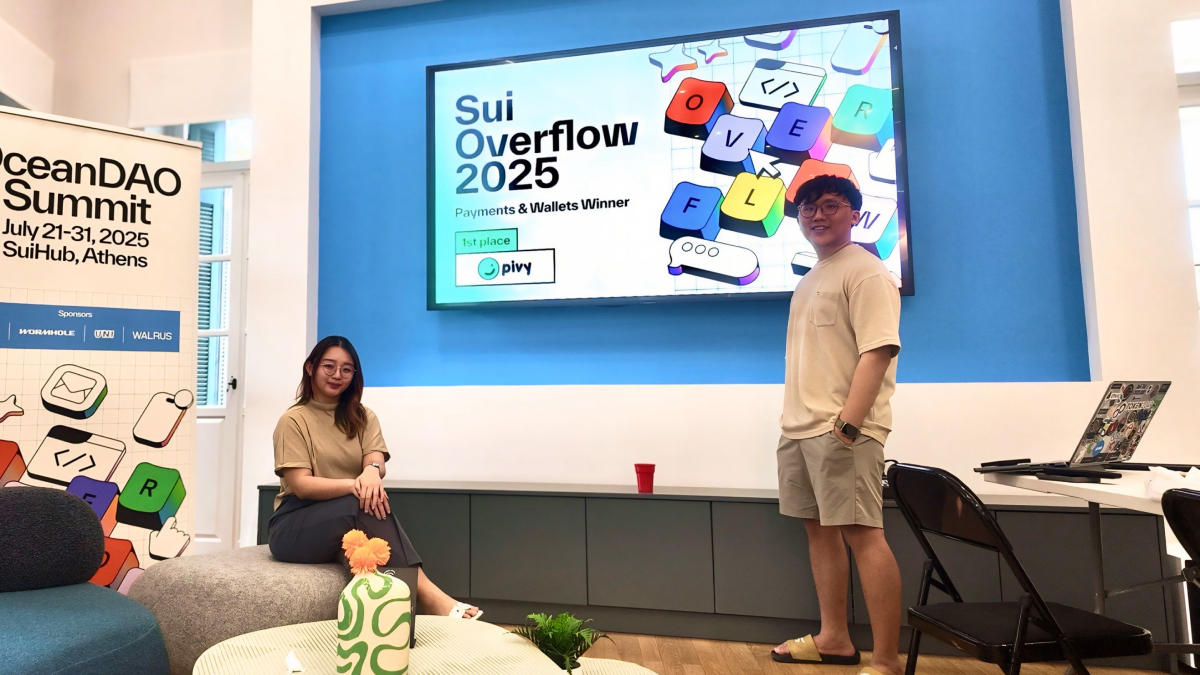
PIVY started as a hackathon project. We won 1st place in the Payment track and 1st place in the community vote. But we didn't want to be just another hackathon win that ships a demo and disappears. So we kept building.
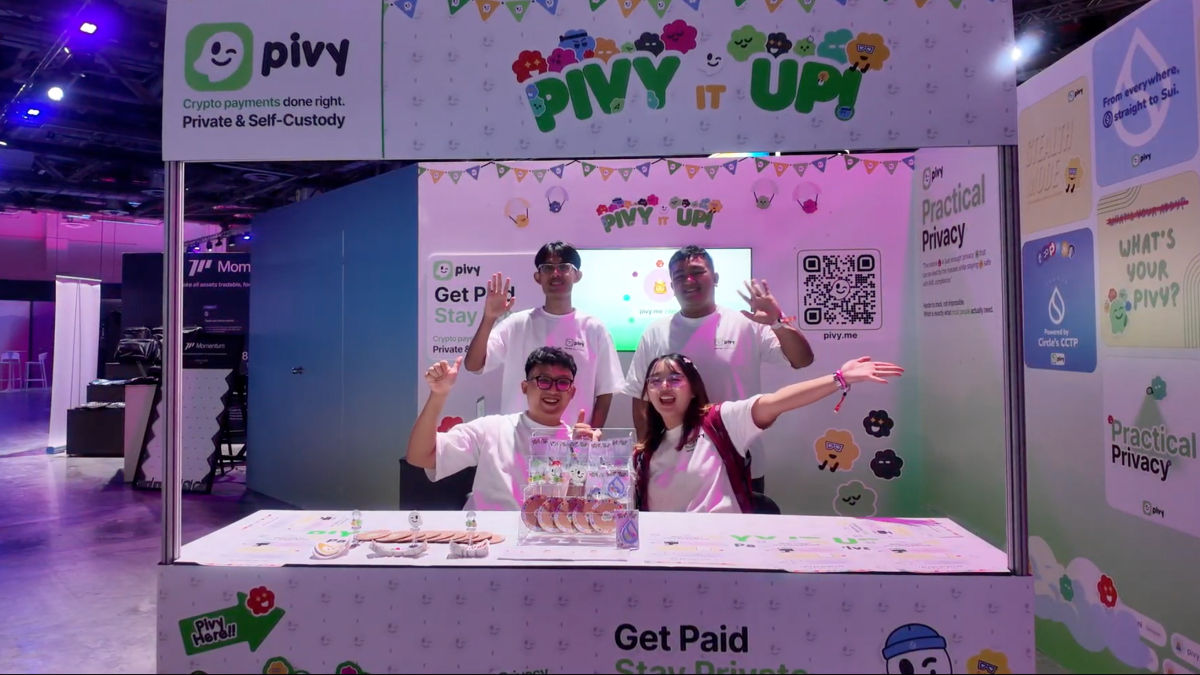
We took the prototype all the way to production. On November 1st, 2025, PIVY launched on Sui Mainnet at SuiFest during Token2049 Singapore. The initial product was simple: create a payment link, share it, receive funds privately with a fresh address every time.
The response was immediate. People understood the value proposition within seconds. No long explanations needed. "I don't want my clients seeing my entire wallet history" is a sentence that resonates with anyone who has ever been paid in crypto.
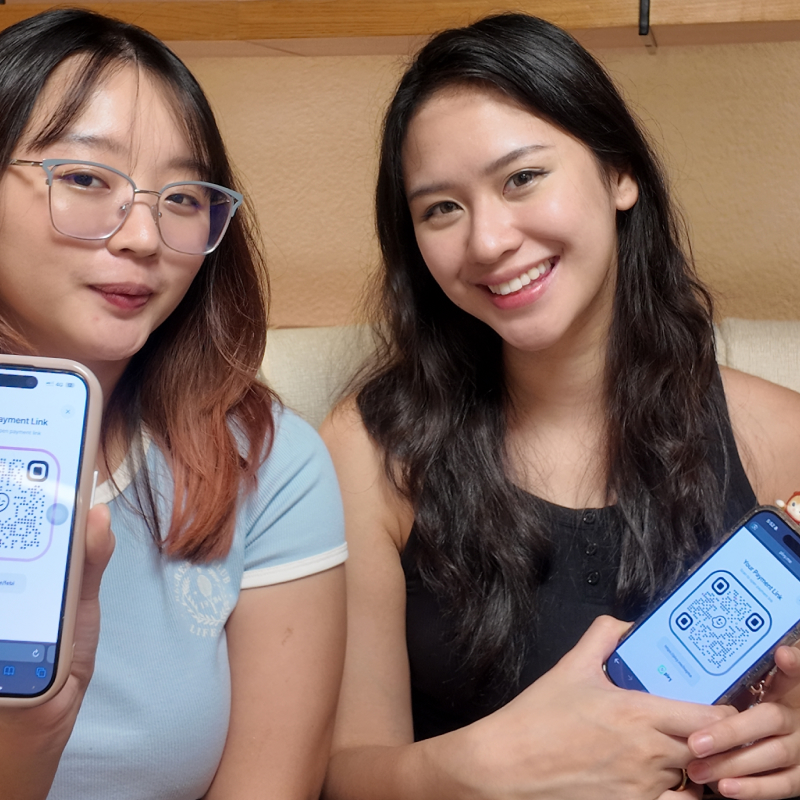
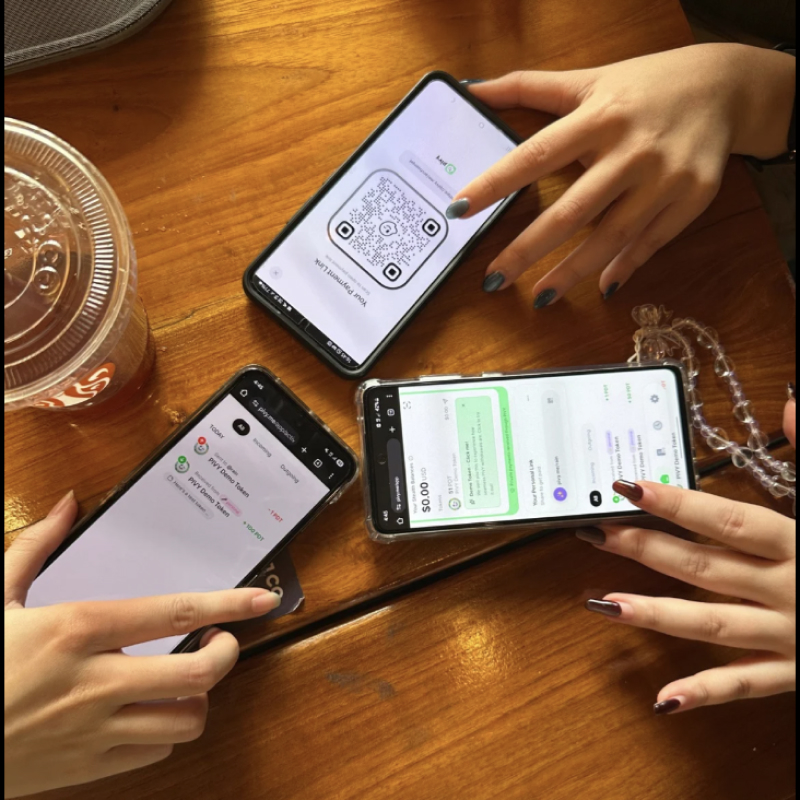

About a month after launch, we got funded. Press Start Capital and the Sui Foundation backed us with a combined $50K, giving us the runway to keep going.
But even with the early traction and funding, we knew stealth addresses alone weren't enough. They give you a fresh address each time, sure. But there's no pooling, no anonymity set. A motivated observer can still correlate the deposits and withdrawals. For real privacy, you need something more.
We needed a privacy pool. But not the kind that makes CEXes nervous about your funds.
The privacy landscape today.
Before explaining our approach, it helps to understand why existing solutions haven't solved this.
ZK Pools
Strong anonymity through zero-knowledge proofs. The math works. But heavy circuits, painful UX, and CEXes tend to flag funds that touch these protocols. The compliance story is rough.
Off-chain Swaps
Services like ChangeNow or HoudiniSwap that handle privacy off-chain. They work, but you're trusting a centralized operator with your funds. Not trustless, not verifiable, and they can disappear tomorrow.
Stealth Addresses
Fresh address per payment. Simple, but no pooling means the anonymity set is one. An analyst can still connect the dots between deposit and withdrawal. Better than reusing one address, not enough on its own.
We needed pool-level anonymity without the ZK baggage, and without trusting a centralized middleman. A privacy pool where compliance is built in, not bolted on.
The breakthrough.
Honestly, in terms of UX and interoperability, the off-chain swap model is the best. Send from any wallet, receive privately, no weird circuits or app lock-in. The only problem is trust. You're handing your funds to a centralized operator and hoping they do the right thing.
Then we found Chainlink CRE (shoutout to them), a pretty new product that runs compute inside secure enclaves (TEEs), verified by multiple independent nodes, results posted on chain. It basically enables the off-chain swap model, but trustless. Nobody can see or tamper with the computation. Not even us.
Pool logic runs in a secure enclave. No one can see deposit-to-withdrawal mappings.
Multiple Chainlink nodes verify the same computation. No single point of trust.
Compliance screening before funds enter the pool. What comes out is verifiably clean.
Real anonymity with a clean compliance trail. CEXes don't need to block PIVY funds because screening happens before anything enters the pool. Privacy with compliance, not against it.
This was the missing piece. We rebuilt PIVY from the ground up on Base with CRE at the core.
How the new PIVY actually works.
The flow is designed to be as close to "normal payments" as possible. The sender doesn't need to know or care about the privacy layer underneath. They just send to an address. Here's the full cycle:
Share
Your PIVY link or ENS name. pivy.me/you. That is all the sender needs. No app install, no platform signup.
Send
The sender gets a fresh ephemeral deposit address. One-time use, generated in TEE. They send from any wallet they want, any chain we support.
Screen & Pool
Compliance check runs inside the TEE. If the source is clean, funds enter the privacy pool. If not, they are rejected. No exceptions.
Receive privately
You get notified instantly. Withdraw to any wallet you want, whenever you want. On chain, there is no link between the sender and your withdrawal address.
The entire process takes seconds from the sender's perspective. They scan a QR or click a link, send from their wallet, done. The privacy happens transparently in the background. No manual steps, no waiting for "mixing rounds," no withdrawal delays.
Paying through PIVY link
Share your pivy.me link, sender pays from any wallet. No signup needed on their end.
Withdrawing on PIVY
Funds are sent from the pool to your destination wallet. No traceable link between sender and receiver.
Paying through ENS
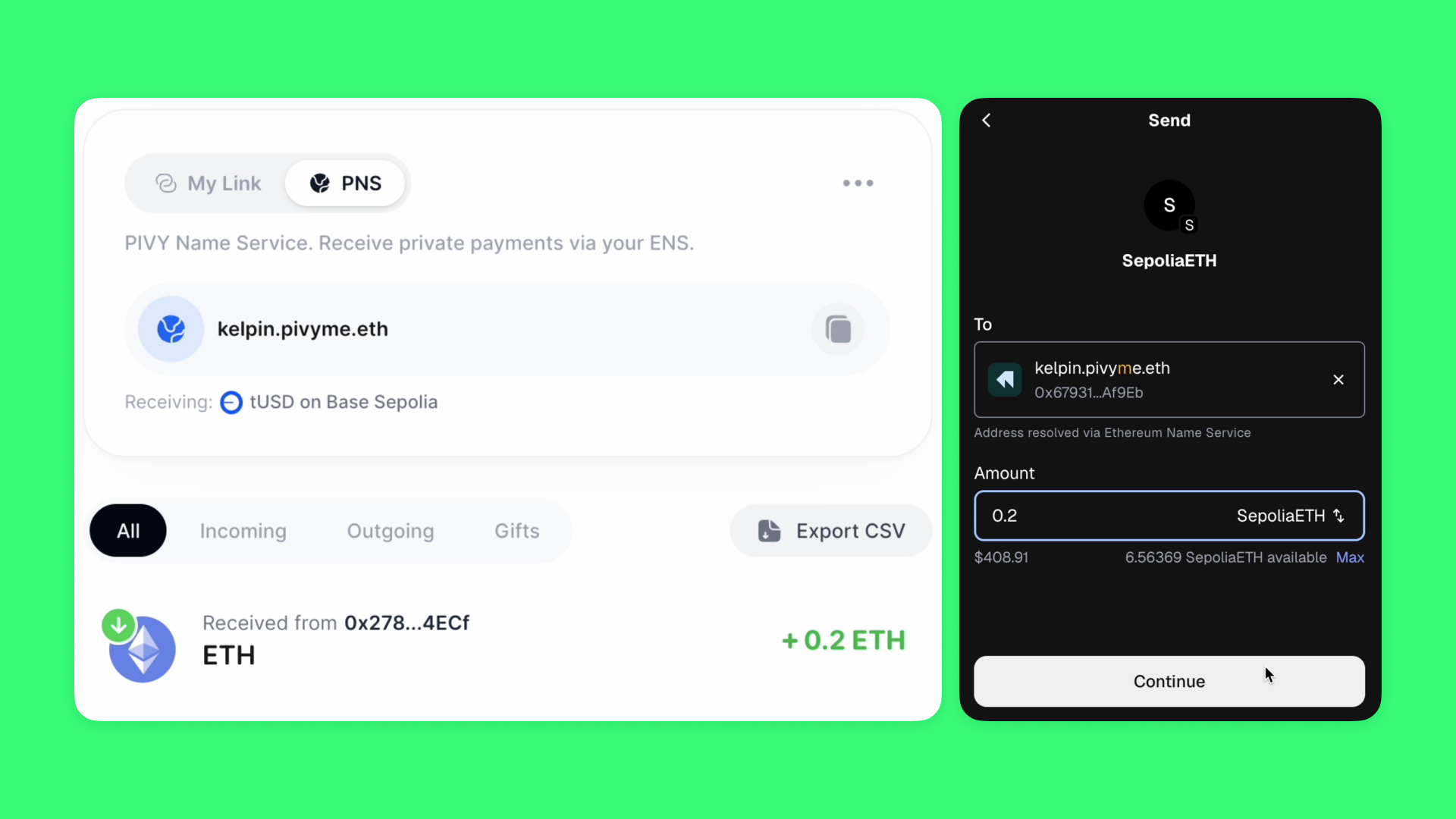
PIVY Name Service. A whole new way to power up your ENS. Just use your ENS name and every payment lands in your privacy pool, privately.
For the receiver, it feels like getting a normal payment notification, except now your financial history is actually yours.
Where we are today.
As of March 14, 2026, with essentially zero marketing spend, PIVY has:
1,000+
Registered users
$450K+
Transaction volume
All organic. No influencer campaigns, no airdrop farming incentives, no paid placements. People found PIVY because they actually needed it. Freelancers who were tired of doxxing their wallet to every client. Creators who wanted to accept donations without exposing their entire portfolio. Teams who needed to pay contributors without leaving a public trail.
These numbers might seem modest compared to projects that raise $50M and buy their way onto every timeline. But every single one of these users signed up because the product solved a real problem for them. That's the kind of traction that compounds.
We're in it for the right reasons.
Let's be honest about the state of crypto. The space is full of projects that exist purely to extract value. Build a protocol, launch a token, pump it, dump it, disappear. Rebrand, repeat. The playbook is well known at this point, and it's the reason so many people are skeptical of new projects.
PIVY is not that. We don't have a token. We're not planning a token sale as our exit strategy. We're not building this to flip it. We're building it because we use it ourselves, because the people around us need it, and because we believe privacy in payments is a fundamental right, not a luxury feature.
"We want to bring privacy to the norm. Not to make it sketchy, not to help bad actors. Just to make it normal for regular people to not broadcast their finances to the world."
The revenue model is simple: we take a small fee on transactions. The product makes money when people use it. Our incentives are aligned with our users. If the product stops being useful, we stop making money. That's how it should work.
We're not here to extract money and move on. We're here because we think this should exist and nobody else built it right. So we did.
Oh, and before you go. Here's a little something we made. Give it a watch.